
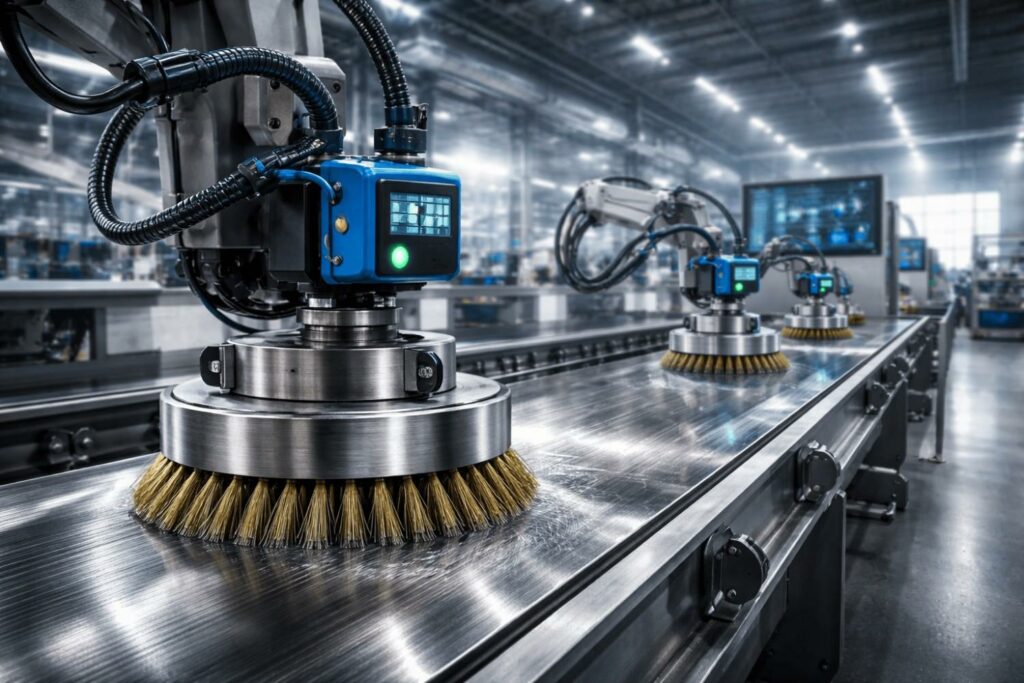
India’s industrial brushes industry is on a steady upward trajectory, with the market estimated at around USD 0.05 billion in 2025 and projected to grow at an annual rate of approximately 5.9%. This growth is driven by rapid industrialisation across automotive, construction and electronics manufacturing. For plant engineers seeking to modernise their operations, sensor-enabled brushes represent a significant opportunity to reduce unplanned downtime and extend equipment life cycles.
This guide provides a practical framework for implementing smart brush technology in your manufacturing facility, with actionable insights for working effectively with industrial brushes manufacturers in India.
Understanding Sensor-Enabled Brush Technology
Sensor-enabled brushes integrate monitoring capabilities directly into industrial brush components, allowing real-time tracking of wear patterns, temperature fluctuations and operational anomalies. This technology transforms brushes from passive consumables into active participants in your predictive maintenance strategy.
Core Sensor Types for Brush Monitoring
Modern sensor-enabled brushes typically incorporate several monitoring technologies. Vibration sensors using MEMS accelerometers can detect frequencies up to 100 kHz, identifying issues with bearings, gearing and lubrication before they cause equipment failure. Temperature sensors monitor thermal variations that indicate abnormal friction or electrical resistance. Wear sensors track material degradation in real time, eliminating guesswork from replacement scheduling.
For rotating equipment applications, tri-axial accelerometers measure velocity, acceleration and displacement simultaneously. This comprehensive data collection enables maintenance teams to identify even subtle changes in brush performance that could indicate developing problems elsewhere in the system.
System Integration Pathways
Sensor-enabled brushes connect to your facility’s monitoring infrastructure through several pathways. Edge computing devices process sensor data locally, reducing latency and enabling immediate alerts when parameters exceed acceptable thresholds. Data is then transmitted via industrial protocols such as MQTT, OPC UA, or EtherNet/IP to centralised monitoring platforms.
Cloud integration allows maintenance teams to access brush performance data remotely, comparing readings across multiple machines and facilities. This connectivity is particularly valuable for organisations with distributed manufacturing operations seeking to standardise maintenance practices.
Benefits for Indian Manufacturing Facilities
The adoption of sensor-enabled brush technology offers compelling advantages for manufacturing plants operating in India’s competitive industrial landscape.
Reducing Downtime and Optimising Replacement
Equipment breakdowns account for approximately 30% of downtime in manufacturing plants, costing businesses millions annually. Sensor-enabled brushes address this challenge by providing early warning of potential failures. Studies show that applying vibration-based predictive maintenance can cut unplanned machine downtime by roughly 30–50% while also prolonging equipment lifespan by 20–40% through earlier fault detection.
Traditional brush replacement follows either calendar-based schedules or reactive approaches—neither of which optimises cost efficiency. Calendar-based replacement often results in discarding brushes with remaining useful life, whilst reactive replacement leads to unplanned production stoppages. Sensor-enabled brushes enable condition-based replacement, where components are changed precisely when wear data indicates the need.
Supporting Quality Control
Brush condition directly impacts product quality in applications ranging from surface preparation to coating removal. Worn or damaged brushes produce inconsistent results that may not be immediately visible but can cause downstream quality issues. Continuous monitoring ensures brushes operate within specified parameters, maintaining consistent output quality throughout their service life.
Implementation Framework for Plant Engineers
Successfully deploying sensor-enabled brushes requires systematic planning and collaboration with your brush supplier. Aviva Brushes works with plant engineers to develop customised implementation strategies that align with existing maintenance workflows and infrastructure.
Assessment and Pilot Programme Design
Begin by auditing your current brush usage patterns and maintenance practices. Identify applications where brush failure has historically caused significant production losses or quality issues. These high-impact applications should be prioritised for sensor integration.
Rather than facility-wide deployment, start with a controlled pilot programme covering three to five critical applications. Select applications that represent different brush types, operating conditions and failure modes to gather comprehensive performance data.
Establish baseline measurements for brush performance, replacement frequency and associated downtime before implementing sensors. This data provides the comparison point for evaluating pilot programme results.
Sensor Selection and Installation
Work with your brush manufacturer to select appropriate sensor configurations for each application. Factors influencing sensor selection include operating temperature range, vibration frequencies, environmental conditions and required data granularity.
Installation should be scheduled during planned maintenance windows to minimise production disruption. Ensure maintenance personnel receive training on sensor calibration, data interpretation and alert response procedures.
Data Integration and Analysis
Connect sensor outputs to your facility’s monitoring platform, configuring appropriate alert thresholds based on manufacturer recommendations and baseline data. Establish escalation procedures for different alert severity levels.
Create dashboards that present brush performance data in actionable formats for maintenance teams. Focus on metrics that directly inform maintenance decisions rather than overwhelming operators with raw data streams.
Selecting the Right Manufacturing Partner
Your choice of brush manufacturer significantly impacts the success of sensor-enabled brush implementation. Evaluate potential partners based on their technical capabilities, support infrastructure and experience with smart manufacturing technologies.
Technical Expertise and Support
Seek manufacturers who understand both brush engineering and sensor technology. This dual expertise ensures sensor integration does not compromise brush performance whilst maximising monitoring effectiveness. Ask potential partners about their experience with specific sensor types and industrial communication protocols relevant to your facility.
Successful implementation requires ongoing support from your brush manufacturer. Evaluate their capacity to provide installation guidance, operator training and troubleshooting assistance. Local support availability is particularly important for facilities requiring rapid response to technical issues.
Quality and Reliability Standards
Sensor-enabled brushes represent a higher investment than conventional brushes, making quality assurance essential. Review manufacturers’ quality control processes, certifications and track records with similar implementations. Request references from other facilities that have deployed their sensor-enabled products.
Overcoming Challenges and Future Developments
Plant engineers frequently encounter obstacles when deploying sensor-enabled brush technology. Understanding these challenges and emerging solutions accelerates successful implementation.
Legacy Equipment and Workforce Development
Many manufacturing facilities operate equipment using older communication protocols such as Modbus RTU or Profibus that are incompatible with modern IoT infrastructure. Protocol converters and gateway devices can bridge this gap, translating sensor data into formats your existing systems can process.
Nearly one-third of manufacturers struggle to find personnel capable of interpreting IoT data and acting on predictive insights. Address this gap through structured training programmes that build data literacy amongst maintenance teams. Focus initial training on alert response procedures and basic data interpretation rather than advanced analytics.
Emerging Technologies
Machine learning algorithms trained on historical brush performance data can predict remaining useful life with increasing accuracy. Sensor manufacturers including Analog Devices, STMicroelectronics and TDK are integrating pre-trained machine learning models directly onto sensor hardware, enabling sophisticated analysis at the edge without requiring cloud connectivity.
Digital twin platforms create virtual representations of physical assets that mirror real-world behaviour in real time. Integrating sensor-enabled brush data into digital twin environments enables comprehensive equipment simulation, supporting maintenance planning and process optimisation.
Taking the Next Steps
Implementing sensor-enabled brushes represents a strategic investment in operational excellence. Begin by identifying high-priority applications where brush monitoring would deliver measurable value. Engage with industrial brush manufacturers in India who can provide both the technical products and implementation expertise your facility requires.
The transition to smart brush technology need not be overwhelming. Phased implementation, starting with carefully selected pilot applications, allows your organisation to build capabilities progressively whilst demonstrating value at each stage.
Aviva Brushes supports plant engineers throughout this journey, from initial assessment through full-scale deployment. Our technical team combines deep brush engineering expertise with practical experience in sensor integration and predictive maintenance strategies, ensuring your implementation achieves its operational and financial objectives.