
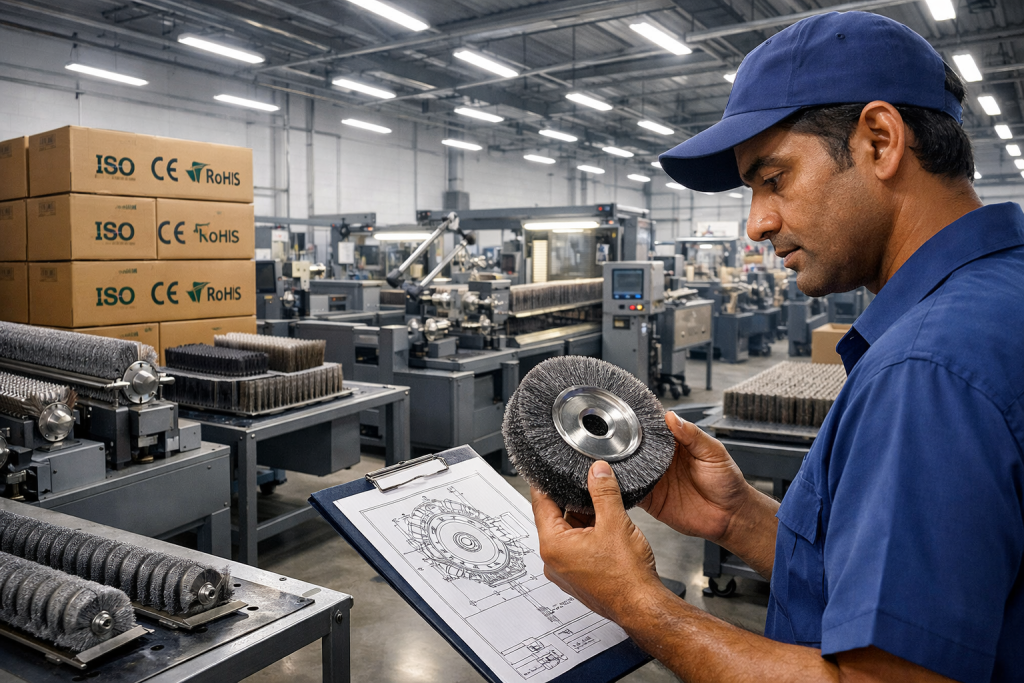
India’s industrial brush manufacturing sector has undergone a remarkable transformation over the past decade. What was once a fragmented cottage industry has evolved into a globally competitive manufacturing ecosystem, with companies from Coimbatore, Chennai, Pune and other industrial hubs now supplying high-quality brushes to clients across North America, Europe and Southeast Asia. By 2026, Indian industrial brush makers aren’t simply winning on cost – they are proving their worth through high standards, reliability and technical skill.
This shift reflects a broader trend in Indian manufacturing. As global supply chains diversify away from single-country dependence, buyers in the UK, Germany, the US and Australia are increasingly looking to India as a reliable alternative. For industrial brush manufacturers in India, this represents both an opportunity and a responsibility to meet the stringent quality standards that international markets demand.
The Quality Certifications That Open Global Doors
Exporting to regulated markets requires more than a good product – it requires documented proof of quality and compliance. For industrial brush manufacturers in India, the most important certifications include:
ISO 9001:2015 is the foundational quality management certification that international buyers expect as standard. It demonstrates that a manufacturer has systematic processes for quality control, traceability and continual improvement. Most serious Indian exporters hold this certification as a minimum requirement.
ISO 14001:2015 covers environmental management systems. European buyers in particular are increasingly requiring this certification as part of their own sustainability commitments, making it an important differentiator for Indian exporters targeting the EU market.
CE Marking is mandatory for industrial brushes sold in the European Economic Area. It confirms that a product meets EU safety, health and environmental protection requirements. Securing CE marking requires detailed technical documentation and, in some cases, third-party testing – a process that progressive Indian manufacturers have invested in to unlock European markets.
RoHS (Restriction of Hazardous Substances) Compliance is essential for brushes containing electrical or electronic components, or those sold to industries where material safety is regulated. RoHS compliance restricts the use of specific hazardous materials in the manufacturing process, and is especially relevant for brushes used in electronics manufacturing, food processing and pharmaceutical applications.
Beyond these, exporters to specific markets may also need to comply with REACH regulations (Europe), FDA guidelines (US food and pharmaceutical sectors) or sector-specific requirements from industries such as automotive, aerospace or textiles.
Modernising Production: Investment in Technology
One of the clearest indicators of India’s growing export capability is the investment that leading manufacturers have made in modern production infrastructure. Automated brush-making machines now handle precision winding, stapling and trimming with tolerances that match European-made equipment. CNC machining ensures that brush cores, holders and mounting hardware are produced to exact specifications, reducing variation and improving consistency across large production runs.
Computer-aided design (CAD) tools allow manufacturers to accept technical drawings from international clients and translate them directly into production specifications, eliminating the communication gaps that once plagued cross-border custom orders. Digital quality management systems track every stage of production, creating audit trails that satisfy the documentation requirements of ISO-certified quality processes.
Indian manufacturers have also invested heavily in testing equipment – hardness testers, pH measurement tools, filament tension gauges and dimensional inspection devices – that enable them to verify product quality before shipment and provide buyers with objective data, not just assurances.
Material Innovations Driving Export Quality
The quality of an industrial brush is ultimately determined by its materials: the filament type, the core material, the bonding agent or stapling system and the backing material. Indian manufacturers have significantly broadened their material capabilities in recent years.
Synthetic filaments including nylon (PA6, PA6.6, PA12), polypropylene, polyester and abrasive nylon (with silicon carbide or aluminium oxide impregnation) are now manufactured and sourced domestically at high quality levels. Natural fibres such as tampico, sisal, coir and horse hair continue to be a strength of Indian production, given the country’s natural fibre heritage.
Metallic filaments – including stainless steel, carbon steel, brass and phosphor bronze wire – are sourced from certified domestic and international suppliers, with material certificates available on request for buyers requiring documented traceability. Specialised materials including food-grade nylon (FDA-compliant), anti-static filaments and heat-resistant fibres for high-temperature applications are also increasingly part of the product range offered by advanced Indian manufacturers.
Quality Control: From Raw Material to Shipment
World-class quality control is not a single checkpoint at the end of production – it is a system that runs through every stage of the manufacturing process. Leading Indian industrial brush manufacturers have adopted incoming material inspection protocols that test raw materials before they enter production. In-process inspections catch dimensional deviations, fill weight variations and filament alignment issues before they propagate through an entire batch.
Final inspection protocols typically include dimensional verification, visual inspection for surface defects, fill density measurement and performance testing where appropriate. For export orders, additional checks may include packaging integrity verification and pre-shipment sampling in accordance with AQL (Acceptable Quality Limit) standards.
Third-party inspection by independent agencies such as SGS, Bureau Veritas or Intertek is increasingly available to international buyers who want an independent confirmation of quality before goods leave India – a service that builds trust and reduces the risk of receiving non-conforming goods.
The Competitive Advantage: Value, Not Just Price
It would be oversimplistic to say that Indian manufacturers compete on price alone. The real competitive advantage lies in the combination of value elements that Indian manufacturing offers international buyers: technically capable products at significantly lower unit costs than European or North American alternatives, combined with the flexibility to accommodate custom specifications, smaller minimum order quantities and responsive communication.
Labour costs in India remain competitive relative to Western manufacturing markets, but this is no longer the primary selling point. Increasingly, it is the combination of engineering capability, production capacity, material range and customer service that makes Indian suppliers an attractive choice. Indian manufacturers can often accommodate complex custom brushes – unusual core geometries, multi-section designs, specialised filament combinations – that smaller buyers struggle to source economically from European suppliers.
How Aviva Brushes Serves the Global Market
Aviva Brushes, based in Coimbatore, Tamil Nadu, is a leading example of an Indian industrial brush manufacturer that has built its business around international quality standards and export capability. We produce a comprehensive range of industrial brushes including strip brushes, tube brushes, disc brushes, wheel brushes and customised brush solutions for industries including textiles, metalworking, food processing, automotive and electronics.
Aviva Brushes’ manufacturing processes are aligned with ISO quality standards, and the company invests continuously in modern production equipment and quality control systems. The team works directly with international clients to understand technical specifications, provide material samples and develop prototypes before committing to full production runs – a process that reduces risk and ensures that the finished product meets the buyer’s exact requirements.
With experience supplying clients in the UK, Europe, the Middle East and Southeast Asia, we understand the documentation, packaging and communication expectations of international buyers. The company provides material certificates, inspection reports and full technical documentation as standard for export orders, and supports customers through the sampling and approval process.
Looking Ahead: The Future of Indian Brush Exports
The trajectory for Indian industrial brush exports is strongly upward. As global buyers continue to diversify their supply chains, India’s combination of manufacturing capability, raw material availability, English-language communication and improving logistics infrastructure positions it well to capture a growing share of global industrial brush procurement.
For buyers currently sourcing from Europe or other Asian markets, 2026 is an excellent time to evaluate Indian suppliers. The quality gap that once existed has narrowed substantially and, in many product categories, Indian manufacturers now offer genuinely comparable quality at meaningfully lower cost – with the added benefit of a supplier relationship that is responsive, flexible and built for the long term.
For industrial brush manufacturers in India like Aviva Brushes, the message to global buyers is clear: we are ready, we are capable and we meet the standards you require.