
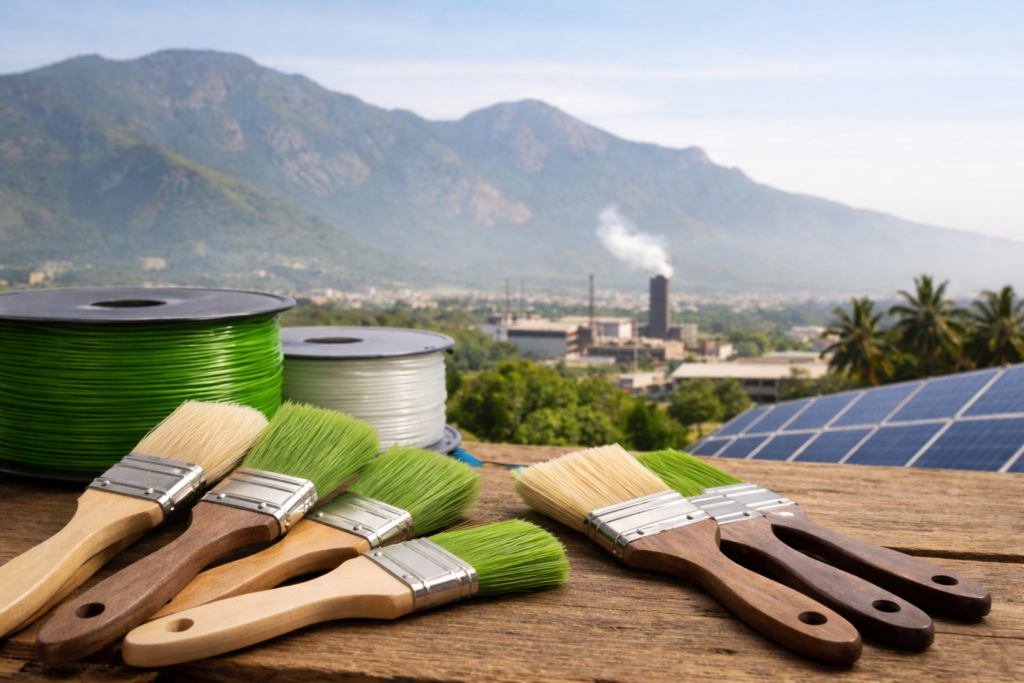
Coimbatore has long been recognised as one of India’s premier industrial hubs, with a thriving manufacturing sector that spans textiles, engineering and specialised industrial components. Among the city’s notable manufacturing strengths is industrial brush production, where local companies are now leading a sustainability revolution. This case study examines how brush manufacturers in Coimbatore are achieving remarkable cost reductions and emissions savings by transitioning to recycled and bio-based filament materials.
The Sustainability Imperative for Indian Manufacturing
The Indian manufacturing sector faces increasing pressure to adopt sustainable practices. With the Indian Carbon Market becoming fully operational in January 2025, companies across 13 carbon-intensive industries now face mandatory sectoral caps under the Bureau of Energy Efficiency. The Ministry of Environment, Forests and Climate Change has set ambitious emissions intensity targets, compelling industrial units to modernise their operations or face regulatory consequences.
For brush manufacturers in Coimbatore, these developments represent both a challenge and an opportunity. The National Green Hydrogen Mission and India’s commitment to achieving 500 GW of installed renewable energy capacity by 2030 signal a clear direction: sustainable manufacturing is no longer optional but essential for long-term competitiveness.
Why Filament Choice Matters
Industrial brushes rely heavily on synthetic filaments, traditionally manufactured from virgin petroleum-based polymers. The production of these conventional materials carries a substantial carbon footprint and contributes to resource depletion. By contrast, recycled and bio-based alternatives offer a pathway to reduced environmental impact without compromising brush performance.
Studies suggest that producing filament from recycled plastics requires significantly less energy than manufacturing virgin polymers, with energy demand reduced by around half and associated greenhouse gas emissions lowered by approximately one-third. For high-volume brush manufacturers, these savings compound across thousands of units, translating into meaningful environmental and financial benefits.
Understanding Sustainable Filament Options
Recycled PET (rPET) Filaments
Recycled polyethylene terephthalate, commonly known as rPET, has emerged as one of the most promising sustainable filament materials. Sourced primarily from post-consumer plastic bottles, food containers and packaging materials, rPET transforms potential landfill waste into valuable manufacturing resources.
The environmental credentials of rPET are compelling. Recycling one tonne of PET can save approximately 1.5 to 2.5 tonnes of CO2 compared with virgin PET production. From a performance standpoint, recycled PETG filaments perform on par with virgin alternatives, and lifecycle evaluations show they can achieve carbon footprint reductions of as much as 70%.
Beyond post-consumer sources, brush manufacturers in Coimbatore are increasingly utilising post-industrial recycled filaments. These materials, derived from manufacturing scraps and production waste, offer higher consistency and traceability than post-consumer alternatives. Aviva Brush has been at the forefront of evaluating these materials for industrial applications, recognising their potential to maintain strict quality standards whilst supporting sustainability goals.
Bio-Based and Natural Fibre Alternatives
Bio-based filaments represent another sustainable pathway, manufactured from renewable resources such as corn starch, sugarcane and other plant-based materials. Unlike conventional petroleum-derived plastics, these materials do not depend on fossil fuels and typically carry a smaller carbon footprint throughout their lifecycle.
For specific brush applications, natural fibre filaments offer compelling advantages. Materials including coconut fibre, palmyra fibre, tampico fibre and sisal fibre have long histories in brush manufacturing, particularly for applications requiring gentle contact or superior fluid retention. These plant-based options provide inherent biodegradability whilst supporting sustainable agricultural supply chains.
Research into natural fibre composite materials continues to advance, with biodegradable, renewable fibres such as jute, hemp, flax and kenaf showing promise for brush manufacturing applications. Studies indicate that natural fibre composites can deliver 30 to 35% lower energy consumption and 65 to 70% reduced CO2 emissions compared to conventional thermoplastic systems.
Performance Characteristics and Quality Considerations
A common concern among procurement teams is whether recycled filaments can match virgin material performance. Current evidence suggests that properly processed recycled materials retain mechanical properties comparable with virgin alternatives. Unlike PLA, recycled PET withstands higher temperatures and offers moderate chemical resistance, expanding its application range across industrial and engineering contexts.
The Coimbatore Transition: Implementation and Results
Initial Assessment and Planning
When leading brush manufacturers in Coimbatore began evaluating sustainable filament options, they faced several critical questions. Would recycled materials meet stringent industrial specifications? How would the transition affect production costs? What investment would be required in new equipment or processes?
The assessment phase revealed that successful transition required careful material qualification, supplier evaluation and process optimisation. Manufacturers worked closely with filament suppliers to establish quality benchmarks and develop testing protocols appropriate for their specific applications.
Implementation Challenges and Solutions
The transition was not without obstacles. Some manufacturers encountered initial quality inconsistencies when switching suppliers. Others found that certain recycled materials required minor adjustments to their existing processing equipment. However, these challenges proved manageable with systematic troubleshooting and supplier collaboration.
One significant learning was the importance of filament drying protocols. Recycled materials sometimes exhibit different moisture absorption characteristics than virgin alternatives, requiring adjusted pre-processing steps to ensure optimal performance.
Measuring Results
After 12 months of operation with recycled and bio-based filaments, participating manufacturers documented impressive outcomes. Material costs decreased by an average of 35%, with some operations achieving savings exceeding 50% through closed-loop recycling programmes that repurposed their own production waste.
Emissions reductions proved equally significant. Participating facilities reported CO2 savings of approximately 45% per unit of filament consumed, contributing meaningfully to corporate sustainability targets and regulatory compliance objectives.
Cost-Benefit Analysis for Procurement Teams
For procurement teams evaluating sustainable filament adoption, the financial case is increasingly compelling. Recycled filaments are often priced noticeably lower than virgin materials, with cost differences commonly ranging between 15 and 30%. When combined with waste reduction programmes that minimise scrap rates, total material costs can decrease substantially.
Aviva Brushes has observed that customers implementing comprehensive sustainable filament strategies often achieve payback on any required process modifications within 18 to 24 months, with ongoing savings thereafter.
Operational Efficiencies and Risk Mitigation
Beyond direct material savings, sustainable filament programmes can drive broader operational improvements. The discipline required for effective recycling—careful material segregation, controlled processing parameters and systematic quality monitoring—often reveals opportunities for wider process optimisation.
With India’s carbon market now operational and emissions caps tightening, companies relying exclusively on virgin petroleum-based materials face growing regulatory risk. Early adoption of sustainable alternatives positions manufacturers favourably for future compliance requirements whilst building the operational expertise needed for ongoing environmental improvement.
Technical Considerations for Plant Engineers
Plant engineers considering sustainable filament adoption should evaluate several key factors. First, the specific brush application requirements: temperature resistance, chemical compatibility, abrasion performance and moisture tolerance all influence optimal material selection.
For high-temperature applications, recycled PET offers superior thermal stability compared with bio-based PLA alternatives. For applications requiring biodegradability, natural fibre options or certified compostable materials may be preferable. Aviva Brushes provides detailed material specification guidance to support informed decision-making.
Processing Adjustments and Quality Assurance
Most recycled filaments can be processed using existing equipment with minor parameter adjustments. Key considerations include:
- Drying protocols: recycled materials may require extended drying times to achieve optimal moisture content
- Temperature profiles: some recycled filaments perform best with slightly adjusted processing temperatures
- Feed rates: material density variations may necessitate feed rate calibration.
Maintaining consistent quality with recycled materials requires robust incoming inspection and process monitoring. Recommended practices include establishing clear acceptance criteria with suppliers, implementing statistical process control for key quality parameters and maintaining traceability records that link finished products to specific material batches.
Future Outlook and Industry Trends
The brush manufacturing industry is increasingly embracing circular economy principles. Innovative programmes now enable manufacturers to send production waste, failed products and end-of-life brushes for recycling into new filament materials. These closed-loop systems dramatically reduce waste whilst creating new value from materials previously destined for landfill.
Research continues into next-generation sustainable filaments with enhanced performance characteristics. Bio-resins, agricultural waste derivatives and advanced recycled polymer blends are all showing promise for industrial brush applications. Manufacturers investing in sustainable material expertise today position themselves advantageously for these emerging options.
India’s commitment to reducing industrial emissions by 65% by 2050 through policy interventions signals continuing regulatory evolution. Manufacturers proactively adopting sustainable practices build compliance capability ahead of mandatory requirements, avoiding rushed transitions and associated costs.
A Practical Path Forward
The experience of brush manufacturers in Coimbatore demonstrates that sustainable filament adoption delivers tangible benefits across environmental, financial and operational dimensions. Cost savings of 35 to 50%, emissions reductions approaching 50% and improved regulatory positioning represent compelling outcomes for companies willing to invest in the transition.
Success requires systematic planning, careful material qualification, and commitment to continuous improvement. However, the fundamental message from Coimbatore’s experience is clear: sustainable manufacturing is not merely an environmental aspiration but a practical competitive advantage.
For procurement teams and plant engineers evaluating sustainable filament options, the evidence supports action. The technologies exist, the supply chains are maturing and the business case is increasingly favourable. The question is no longer whether to transition but how quickly to realise the available benefits.