
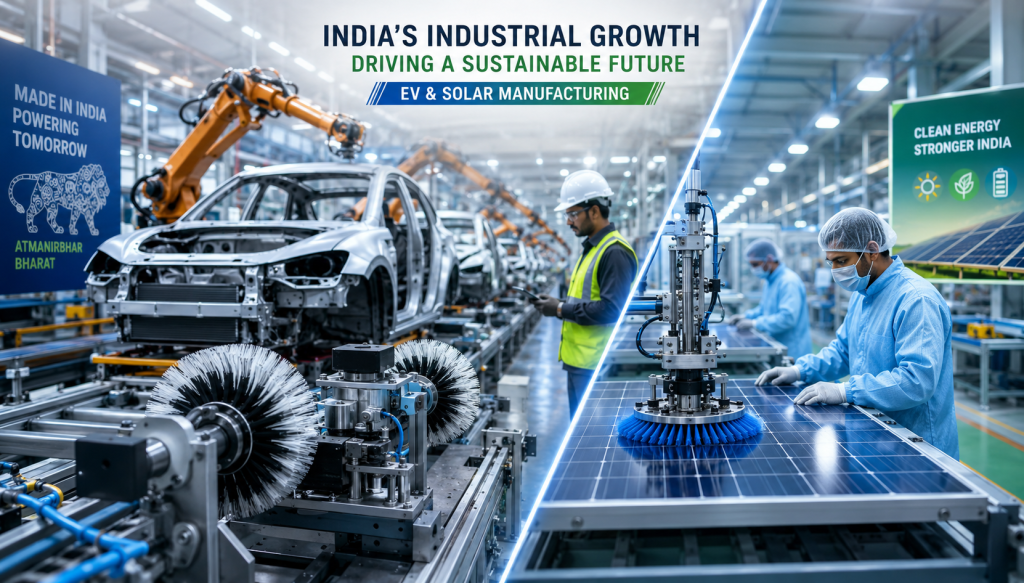
India’s electric vehicle and solar energy sectors are experiencing unprecedented growth, creating new opportunities and challenges for industrial brush manufacturers in India. As these industries scale up production to meet ambitious government targets, procurement teams and plant engineers must understand evolving brush requirements, quality standards and supply chain dynamics that will define success in 2026. The convergence of technological advancement and sustainability mandates is reshaping how manufacturers approach component sourcing, particularly for critical applications where brush performance directly impacts production efficiency and product quality.
The Growing Market Landscape for Industrial Brushes in India’s Green Energy Sectors
EV Market Projections and Manufacturing Scale-Up
India’s commitment to achieving 30% electric vehicle adoption by 2030 is driving unprecedented manufacturing expansion across the automotive sector. This ambitious target translates to an estimated 102 million electric vehicles on Indian roads, requiring massive scaling of domestic production capabilities. Manufacturing facilities are investing heavily in advanced production lines, creating substantial demand for specialised industrial brushes that meet automotive-grade specifications. The shift from traditional internal combustion engines to electric powertrains demands entirely new brush applications, particularly in battery manufacturing and motor assembly processes.
Solar Industry Expansion and Production Demands
The solar manufacturing sector presents equally compelling opportunities, with India targeting expansion from 70GW to 500GW installed capacity. This seven-fold increase necessitates dramatic scaling of photovoltaic cell and panel production, driving demand for precision brushes throughout the manufacturing value chain. Silicon wafer processing, cell assembly and quality control processes all require specialised brush solutions that can maintain performance under stringent clean room conditions whilst delivering consistent results across high-volume production runs.
Government Policy Impact on Industrial Component Requirements
The Production Linked Incentive (PLI) schemes are fundamentally reshaping procurement strategies, with manufacturers increasingly prioritising domestic suppliers who can demonstrate quality parity with international alternatives. This policy environment creates significant opportunities for Indian brush manufacturers who can achieve international certification standards whilst offering competitive lead times and localised support. Compliance with emerging quality standards and traceability requirements is becoming essential for suppliers seeking to participate in these high-growth sectors.
Critical Brush Applications in EV Manufacturing Processes
Battery Production Line Requirements
Lithium-ion battery cell manufacturing demands exceptional precision and contamination control, placing stringent requirements on brush specifications. Anti-static brushes with controlled conductivity are essential for handling sensitive battery components without risking electrostatic discharge damage. The cell coating and drying processes require brushes capable of operating in high-temperature environments whilst maintaining dimensional stability and filament integrity. Quality control applications demand brushes with ultra-fine filaments for detecting surface irregularities that could compromise battery performance or safety.
Motor Assembly and Testing Applications
Electric motor production requires precision cleaning brushes for component preparation and assembly line applications. Rotor and stator manufacturing processes utilise specialised brushes for surface preparation, ensuring optimal magnetic properties and electrical performance. Conductive brushes play critical roles in motor testing equipment, requiring precise electrical characteristics and extended operational life under repetitive testing cycles. The increasing complexity of motor designs demands custom brush solutions tailored to specific geometric requirements and performance parameters.
Surface Treatment and Quality Control Processes
Clean room environments in EV manufacturing facilities require brushes meeting strict contamination control standards. Static-dissipative brush solutions prevent particle generation whilst maintaining effective cleaning performance across sensitive component surfaces. Visual inspection processes utilise precision brushes for removing microscopic contaminants that could interfere with automated quality control systems. These applications demand brushes with validated cleanliness levels and documented particle shedding characteristics.
Solar Panel Manufacturing: Brush Specifications and Performance Standards
Silicon Wafer Processing Applications
Photovoltaic cell production begins with silicon wafer processing, where ultra-fine filament brushes remove microscopic surface contaminants without damaging the crystalline structure. These specialised brushes must operate effectively in chemical environments whilst maintaining consistent performance across thousands of processing cycles. Wafer texturing processes require brushes with precisely controlled abrasive characteristics to achieve optimal light-trapping surface geometries. The demanding nature of these applications necessitates brushes manufactured from high-performance materials with validated chemical compatibility.
Panel Assembly and Cleaning Systems
Solar panel assembly processes utilise brushes for applying conductive adhesives and removing excess materials from cell interconnections. Automated cleaning systems require brushes with extended operational life and consistent performance characteristics to maintain production line efficiency. Filament durability becomes critical in high-temperature lamination processes where brushes must maintain effectiveness despite thermal cycling. Quality assurance applications demand brushes capable of detecting surface defects that could impact panel electrical performance or long-term reliability.
Quality Assurance and Testing Equipment
Final inspection processes in solar manufacturing rely on precision brushes for preparing panel surfaces prior to electrical testing. These applications require brushes with validated electrostatic discharge properties to prevent damage to sensitive photovoltaic cells. Automated testing equipment utilises custom brush solutions designed for repetitive contact applications whilst maintaining electrical and mechanical performance standards. The increasing sophistication of quality control systems demands brushes with traceable performance characteristics and documented reliability data.
Supply Chain Challenges and Opportunities for Indian Manufacturers
Raw Material Sourcing and Sustainability Requirements
Environmental consciousness in procurement decisions is driving demand for sustainable filament materials, including recycled and bio-based alternatives. Aviva Brushes has recognised this trend, developing innovative filament compositions that meet performance requirements whilst reducing environmental impact. Supply chain resilience considerations are encouraging manufacturers to diversify raw material sources and develop local supplier networks. The complexity of modern brush applications requires sophisticated material science capabilities and extensive testing protocols to validate new filament compositions.
Lead Time Optimisation for Growing Demand
Rapid market expansion is creating pressure for reduced delivery timescales, with lead time optimisation becoming a critical competitive differentiator. Manufacturers investing in advanced production planning systems and flexible manufacturing capabilities can respond more effectively to fluctuating demand patterns. The seasonal nature of solar installation cycles creates specific challenges for capacity planning and inventory management. Successful suppliers are implementing advanced forecasting systems and building strategic inventory positions to support customer requirements.
Quality Certification and International Standards
International quality certifications are becoming mandatory requirements for suppliers to EV and solar manufacturers seeking global market access. ISO 9001 certification provides the foundation, but sector-specific standards such as TS 16949 for automotive applications are increasingly required. Suppliers must demonstrate comprehensive quality management systems with full traceability and statistical process control capabilities. The complexity of certification requirements demands significant investment in quality infrastructure and documentation systems.
Technology Integration and Advanced Brush Solutions
Sensor-Enabled Brushes for Industry 4.0 Applications
The integration of Internet of Things (IoT) technology into manufacturing processes is creating opportunities for smart brush solutions with embedded monitoring capabilities. Sensor-enabled brushes can provide real-time data on wear patterns, performance degradation and maintenance requirements. This technological advancement enables predictive maintenance strategies that minimise unplanned downtime and optimise brush replacement schedules. Aviva Brushes is pioneering these advanced solutions, combining traditional manufacturing expertise with cutting-edge sensor technology.
Predictive Maintenance and IoT Integration
Advanced manufacturing facilities are implementing comprehensive predictive maintenance programmes that rely on continuous monitoring of critical components. Smart brush systems can integrate seamlessly with existing manufacturing execution systems, providing actionable insights for maintenance planning. Data analytics capabilities enable identification of performance trends and optimisation opportunities that traditional maintenance approaches cannot achieve. The resulting improvements in equipment availability and product quality justify the investment in advanced brush technologies.
Custom Engineering for Specific Applications
The unique requirements of EV and solar manufacturing processes often demand custom brush solutions that cannot be satisfied by standard product offerings. Advanced engineering capabilities enable development of application-specific designs optimised for particular operational requirements. Collaborative development programmes between brush manufacturers and end users result in innovative solutions that deliver superior performance and cost-effectiveness. These partnerships create competitive advantages for both parties through improved process efficiency and reduced total cost of ownership.
Strategic Recommendations for Procurement Teams and Plant Engineers
Vendor Selection Criteria for 2026
Successful vendor selection requires comprehensive evaluation of technical capabilities, quality systems and supply chain resilience. Manufacturing capabilities should encompass both standard products and custom engineering services to support evolving application requirements. Financial stability and investment in advanced manufacturing technologies indicate suppliers’ commitment to long-term partnership success. Reference customers in similar applications provide valuable insights into supplier performance and reliability under demanding operational conditions.
Cost Optimisation Strategies
Total cost of ownership analysis should encompass initial purchase price, installation costs, operational performance and maintenance requirements. Extended brush life and improved process efficiency often justify premium pricing for high-performance solutions. Volume consolidation strategies can achieve cost reductions whilst simplifying supply chain management and quality assurance processes. Strategic partnerships with subcomponent product suppliers enable collaborative cost reduction initiatives and joint development programmes.
Risk Mitigation and Supply Security
Dual sourcing strategies provide insurance against supply disruptions whilst maintaining competitive tension between suppliers. Local sourcing preferences under Atmanirbhar Bharat initiatives create opportunities for Indian manufacturers who can demonstrate quality and delivery reliability. Comprehensive supplier auditing programmes ensure ongoing compliance with quality and delivery requirements. Strategic inventory management balances carrying costs against the risk of production disruptions due to component shortages.
The convergence of India’s EV and solar manufacturing boom presents significant opportunities for industrial brush manufacturers in India who can meet evolving technical specifications and supply chain demands. Success in 2026 will depend on manufacturers’ ability to deliver sustainable, high-performance brush solutions with competitive lead times whilst maintaining the quality standards these critical industries require. Strategic partnerships between component suppliers and manufacturers will drive innovation and operational excellence, supporting India’s ambitious clean energy and transportation electrification goals. For procurement teams and plant engineers, selecting the right brush suppliers will be crucial for maintaining production efficiency and product quality in these rapidly expanding sectors.